
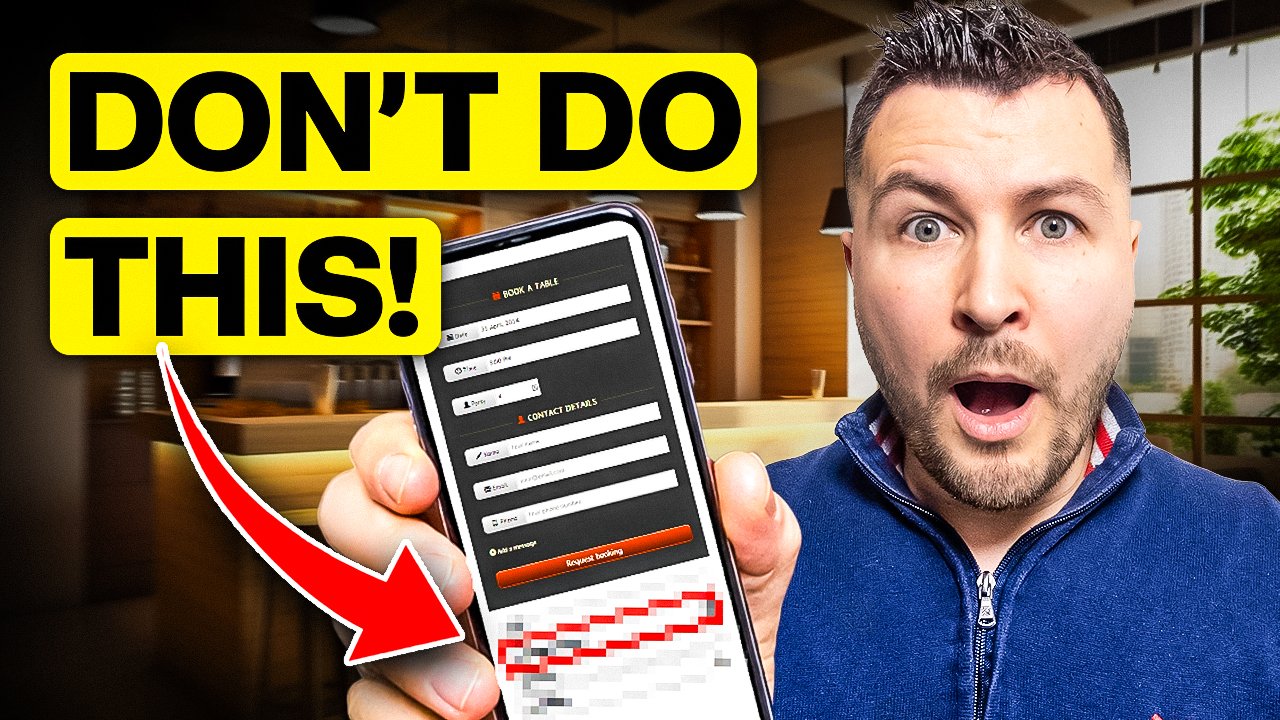
Every time you add a new booking rule, you think you’re protecting your business. You’re not. You’re adding friction before the guest has even arrived. And guests who arrive confused, caught off guard by a restriction they didn’t expect, or already irritated by a complicated booking process, don’t come back.
I’m Tom Dimelow, a restaurant and hospitality coach with over 15 years of experience across hospitality and accounting. At 22, I opened a restaurant inside a 5-star hotel alongside British TV chef James Martin, earned an AA rosette in the first year, and turned over 7 figures. I’ve since worked with independent restaurant owners across the UK to help them build more profitable, more consistent operations.
In this post, I’m going to show you why the rules you’re adding to protect your business are quietly hurting it, and what to do instead. Because knowing how to run a restaurant well isn’t just about what happens during service. It starts the moment someone tries to book.
The Real Cost of Booking Restrictions
Independent restaurants are under serious pressure right now. No-shows cost you revenue. Margins are tight. Every missed cover feels like a hit you can’t absorb. So operators do what feels logical: they add deposits, restrictions, and tighter booking conditions to protect seats and protect income.
The problem is the unintended consequence. Every condition a guest has to work through before they arrive adds to their cognitive load. More cognitive load means a worse first impression. And in hospitality, the guest experience doesn’t start when someone walks through your door. It starts the moment they try to book.
If your booking process is full of terms, conditions, and restrictions they need to get their head around, you’ve already put them in the wrong frame of mind before they’ve set foot in the place. More rules means more confusion, more friction, and a first impression that is much harder to recover from.
Before you tell me you’ll add the rules to your terms and conditions: people don’t read them. Hiding restrictions there delays the problem until the guest is already sitting at the table, which is the worst possible moment for that conversation to start.
You’re Controlling the Wrong Thing
Here’s an example that makes this concrete. I recently attended a lunch with a client who had been shortlisted for an award. Six of us, a genuine reason to celebrate, an occasion that was supposed to feel special for everyone at the table.
The problem was that the owner had booked somewhere slightly outside his budget, and was quietly hoping everyone would order from the set lunch menu, which represented much better value for money. When we arrived, we were told the lunch menu was only available for tables of fewer than six. He hadn’t seen that restriction in the booking.
The anxiety he felt in that moment was significant. He couldn’t afford for everyone to order from the à la carte, but he couldn’t say that. He felt embarrassed for not knowing the rule, and the rule had been presented as simply “the way it is,” buried somewhere in the booking details. The atmosphere deflated before anyone had ordered a drink.
Instead of pre-dinner drinks, wine with the meal, and a full celebration, the group moved somewhere cheaper for drinks and kept the food bill as low as possible. The restaurant lost significant revenue from a table that had every reason to spend well.
The restaurant wasn’t wrong to have the rule. The guest wasn’t wrong to book. The problem was a restriction that was convoluted, easy to miss, and created an uncomfortable situation the moment we arrived.
This is what happens when operators try to control guest behaviour instead of guest experience. You cannot control whether someone reads your booking terms. What you can control is how effortless the experience of booking with you feels. Stop trying to control people’s behaviour. Start controlling the experience they receive.
What To Do Instead
Deposits are a legitimate tool, but they’re not neutral. 82% of guests are willing to pay a deposit for larger table bookings. For fine dining, anywhere between £1 and £50 is considered reasonable. For casual dining, £1 to £25. The issue is when deposits become a blanket rule applied to all bookings.
Before you introduced a deposit, you might have had 150 bookings with 10 no-shows. After introducing one, you might have 120 bookings with none. That looks like progress. But you’ve lost 20 people who would have turned up. They wanted to eat out but weren’t committed enough to pay in advance. The real question is: are you filtering out risk, or quietly killing demand?
Deposits also create stories. If a guest has to cancel due to a bereavement and you refuse to refund their deposit, that story travels faster than any marketing you’ll ever put out.
The practical fixes are straightforward:
- Let small tables book freely online. Two to six covers, no conditions, full menu access. Make it three clicks and done.
- Move large bookings to a phone call. That conversation gives you the chance to explain any restrictions clearly, and gives the guest the opportunity to decide whether the experience is right for them before they arrive.
- Confirm everything in writing. After the call, send a template email that covers everything discussed. No ambiguity, no surprises on the door.
- Apply fair refund policies. If you’ve taken a deposit and you resell those seats, refund it. It costs you nothing and protects your reputation.
- Make menu availability obvious. If there are restrictions on what certain tables can order, that information must be impossible to miss. Not buried. Not in the small print.
If you must have rules, make them simple, fair, and easy to understand.
Conclusion: How to Run a Restaurant People Want to Return To
Simplicity wins in hospitality. Fewer rules, clearer offers, and a booking process that feels effortless will do more for your repeat business than any restriction you put in place.
The operators with the strongest return rates aren’t the ones with the most robust booking policies. They’re the ones who make it so easy and enjoyable to visit that guests don’t want to cancel. A meal someone is genuinely looking forward to doesn’t need a deposit to secure it. You’ll find that a long waiting list does more to ensure people don’t miss their booking than any deposit ever will.
Your job isn’t to manage risk through restriction. It’s to create an experience worth returning to.
Ready to find out what’s really holding your restaurant back?
Take the free 5-minute assessment and get a personalised scorecard across four key areas: accounting, sales, hospitality, and training. You’ll know exactly where to focus.
Take the Free 5-Minute Restaurant Assessment Here
Frequently Asked Questions
1. Do restaurant deposits actually reduce no-shows?
Yes, deposits do reduce no-shows, but the impact on overall revenue is less straightforward than it looks. Restaurants that have introduced deposits typically see fewer cancellations, but also fewer bookings overall. Guests who were considering booking but weren’t fully committed often choose not to if a deposit is required. Before introducing a blanket deposit policy, consider whether the guests you’re filtering out were likely to spend well, and whether the reduction in no-shows is worth the reduction in demand.
2. How much should I charge as a restaurant booking deposit?
Research suggests that 82% of guests are willing to pay a deposit for larger table bookings. For fine dining restaurants, anywhere between £1 and £50 is considered reasonable. For more casual dining environments, £1 to £25 tends to be the acceptable range. The key is to apply deposits selectively, particularly for larger bookings where the risk of a no-show has a material impact on your revenue for that service.
3. What’s the best way to handle large group bookings without creating friction?
Move large group bookings to a phone call rather than an online form. The conversation gives you the opportunity to explain any restrictions or requirements clearly, and gives the guest the chance to confirm they’re comfortable with those terms before committing. After the call, follow up with a written confirmation covering everything discussed. This approach reduces the risk of misunderstandings on arrival without creating the kind of friction that a complex online booking process generates.
4. Should I put my booking rules in the terms and conditions?
No. Terms and conditions are not read. Placing restrictions there creates the impression that the booking process is straightforward, only for the guest to discover a problem when they arrive. If you have rules that affect the guest experience, they need to be visible, clear, and impossible to overlook during the booking process itself. If a rule is too complicated to explain upfront, that’s often a sign the rule itself needs simplifying.
5. What should I do if a guest asks for a deposit refund after cancelling?
A fair and clearly communicated refund policy protects your reputation as much as it protects your revenue. If a guest cancels in advance and you’re able to resell the table, refunding the deposit costs you nothing and generates goodwill. If a guest has to cancel due to circumstances outside their control, a rigid no-refund policy risks creating a negative story that spreads far beyond that one guest. Consider building a refund policy into your booking confirmation, so expectations are set clearly from the start.
Leave a Reply